
Voting Results
During the one-day workshop "Digital Democracy Camp" on May 23, 2025, participants were first introduced to the basic concepts of digital democratic processes. Another focus was on teaching methodological basics for formulating hypotheses and arguments, especially with regard to clear, verifiable, and constructive statements. After this introductory phase, participants worked in five topic-specific groups, known as theme tables.
Each group dealt intensively with a given topic and was accompanied by experts in the respective subject area. The aim of this work phase was to formulate two theses or arguments per group based on the content developed, which had a concrete reference to KIT. The groups then presented their theses in plenary. These were discussed together, reflected on constructively, and, where necessary, further developed in terms of content and language. This ensured that the final theses were comprehensible, differentiated, and formulated in a way that was understandable for all participants. In this way, the collected theses were to serve as a list of demands, a "charter," providing guidance for improving the democratic situation at KIT.
At the end of the workshop, several votes were held. First, each thesis was evaluated individually, followed by an overall evaluation of all theses across all topics. The voting results collected during this process form the basis of the following presentation of results and reflect the assessments and opinions of the participants at the time of the workshop.
Presentation and Classification
The voting results for each statement are presented in the form of two graphics per thesis. Each graphic depicts two different evaluation dimensions to allow for a differentiated assessment of the theses.
The first graphic (left) shows the extent to which participants agree with the respective thesis and the significance or importance they attach to it. The combination of these two dimensions makes it clear whether a thesis not only receives approval in terms of content, but is also perceived as relevant to the discourse on digital democracy at KIT.
The second graphic (right) refers to the perceived supportability of the thesis within KIT. Participants estimated the extent to which they believed the thesis would be supported by students and the extent to which it could receive support in the rest of the KIT environment. This assessment allows for a classification of the theses in regard to their potential acceptance beyond the one-day workshop.
Together, both graphics allow for a holistic view of the theses by taking into account personal agreement and relevance as well as expected institutional support.
Theme Table Oligarchy

The thesis "All meetings of elected bodies should be public and the protocols should be accessible" was supported by a majority of participants and considered relevant. Furthermore, it was attributed a comparatively high potential acceptance among students, while the expected support within the rest of the KIT community was assessed as considerably more reserved.

The thesis "The Senate should be allowed to (co-)decide on matters of strategy (structural and development plan as well as construction development planning) and finance (economic and financial plan)" is supported by a majority of the participants and considered relevant. At the same time, the results show that the expected support, particularly within the broader institutional environment of KIT, is assessed differently.
Theme Table Citizens' Councils
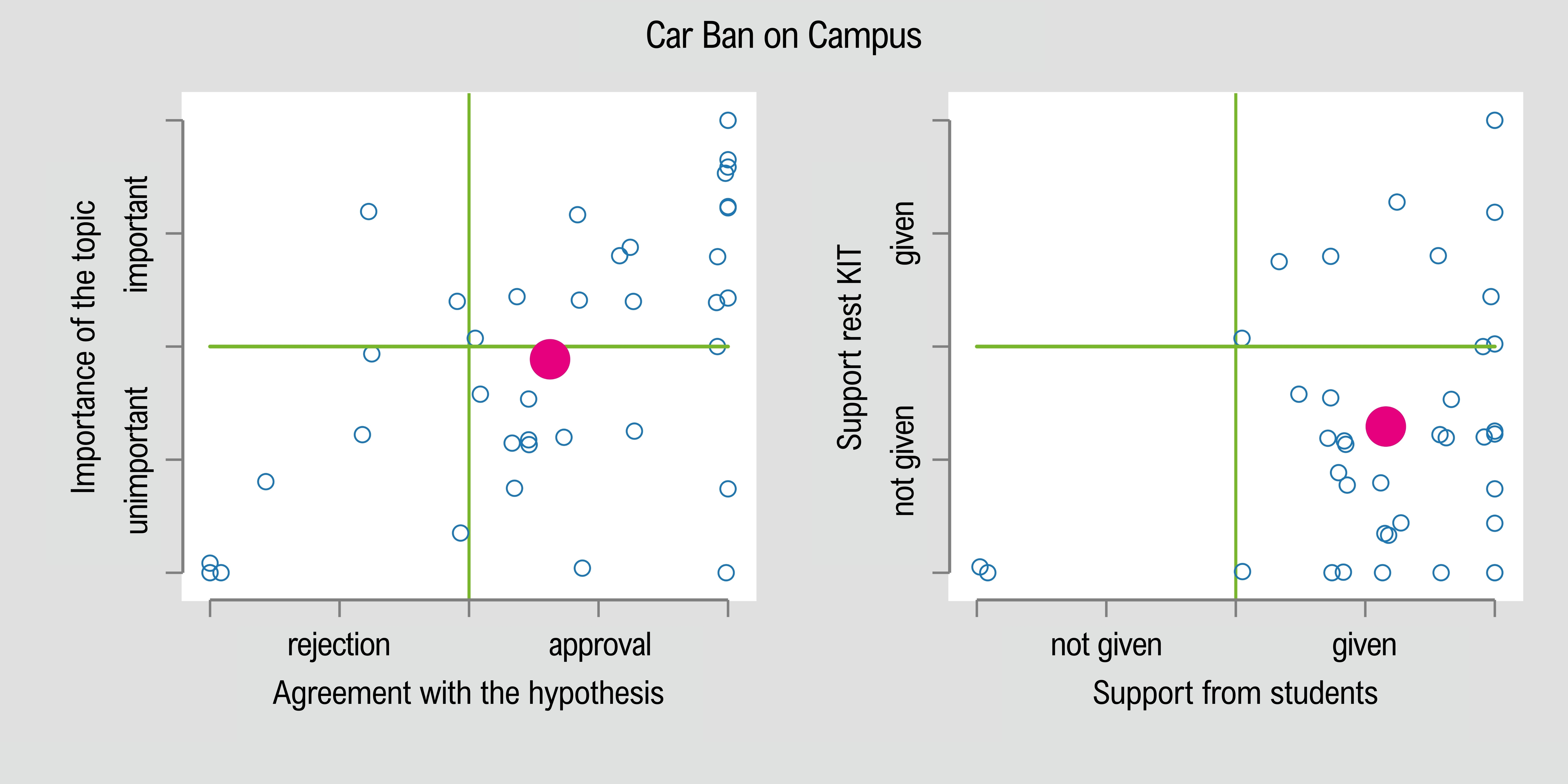
The thesis "A car ban on the south campus would increase the sense of security for a large majority" is partly supported by the participants, but is viewed as clearly controversial both in terms of its relevance and its institutional feasibility.

The thesis "KIT should introduce student citizens' councils for certain university policy decisions" was predominantly viewed positively by the participants and perceived as relevant to the discourse at KIT. At the same time, the results show that while the expected support within KIT is generally present, it is assessed inconsistently, particularly at the institutional level.
Theme Table Social Networks

The thesis "KIT should conduct research on democracy" was rated highly by the participants as highly relevant and agreeable. Furthermore, it was attributed strong support within KIT, making it particularly likely to garner consensus compared to other theses.

The thesis "Ilias and other future digital platforms of KIT must offer the option of pseudonymization, which can only be revoked by an independent body in order to sanction violations of community guidelines" was evaluated very differently by the participants. Both the substantive agreement and the perceived relevance and supportability were less clear than with other theses.
Theme Table Back to Basics

The thesis "KIT should provide spaces for democratic practice" is rated highly by participants in terms of agreement and relevance. Furthermore, it was perceived as having strong support within KIT.

The thesis "There should be a suitable digital process to initiate direct voting on topics relevant to students" was rated highly by the participants as being of high relevance and widely accepted. Furthermore, it was attributed strong support within KIT.
Theme Table Civil Society

The thesis "KIT should provide an open source hub to support civil society in the digital transformation" is rated with high approval and relevance by the participants and is also considered to be well integrated within KIT.

The thesis "Democratic education and the application of democratic practices should be a mandatory part of the curriculum at KIT" was predominantly viewed positively by the participants and considered particularly important. Furthermore, it was attributed with good support within KIT, although the assessments were not entirely uniform.
Overall Evaluation of all Theses
In a final vote, all of the theses developed were evaluated collectively. Each participant had a total of 100 points available, which could be distribute in increments of 10 across the ten theses in order to set individual priorities and weight the theses differently. Based on the number of theses, this results in a theoretical average value of 10 points per thesis. This value was set as a reference or threshold value for closer examination. The results show that three theses exceed the reference value of 10 points and were thus assessed as particularly high-priority topics. The highest average score was given to the thesis on digital voting, followed by the demand for public protocols and the thesis on democracy research at KIT. These three theses can be interpreted as the participants' central priorities. In summary, the overall evaluation shows that the participants clearly focused on digital participation formats, transparency, and a stronger anchoring of democracy research at KIT.
